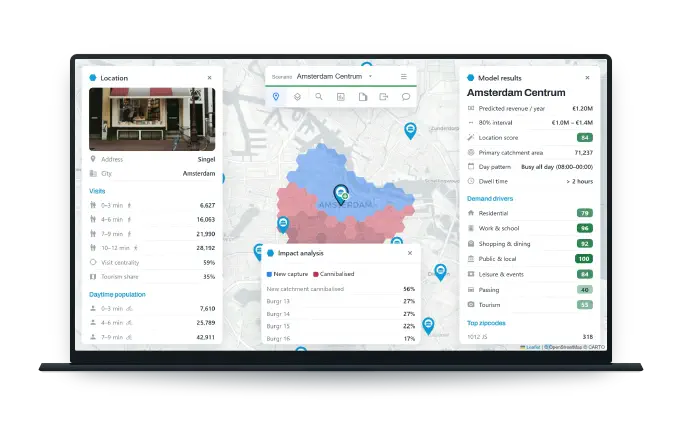
No tool is right for every job. Here is when one of these is the better buy than IRIS.
The forecasters weighed alongside IRIS in Europe
Each of these is a capable product with real data and real clients. What follows is what each is good at, where IRIS is different, and when to buy them instead. Everything said about a vendor was read from their public materials on 24 July 2026, and "not published" means we did not find it, not that they cannot do it.
IRIS vs RetailSonar
RetailSonar positions itself as a Benelux market leader, with a large curated footfall and car-passage data layer and a long retail client list. The difference is what you can check: IRIS publishes its licence bands and its build price, and it measures its error on stores you already run before you commit, where RetailSonar's forecast is a quote-based engagement. Buy RetailSonar if that data depth and enterprise delivery fit you and a quote is fine.
IRIS vs Targomo
Targomo is leading travel-time and isochrone routing, with a published pay-per-use developer API. It is a different layer of the stack: Targomo tells you what is reachable, IRIS tells you what a site will earn and how sure you can be, as a revenue forecast with an 80% interval and the demand drivers behind it. Many teams use reachability data and a forecast for different jobs. Buy Targomo if you need routing and reachability infrastructure to build on.
IRIS vs Geoblink (MyTraffic)
Geoblink, now part of MyTraffic, is a broad location-intelligence dashboard covering catchment, cannibalisation and territory, with a sales forecast as one feature and MyTraffic footfall data behind it. IRIS is narrower on purpose: it does one job, and it publishes the range around every forecast and its out-of-sample error on your own estate. Buy Geoblink if you want the wider dashboard and forecasting is one need among several.
IRIS vs Geolytix
Geolytix builds consultant-led models with driver explainability, from an established UK data-science team. The difference is ownership and repeatability: IRIS is a platform your own team re-runs the moment the site list moves, with the model and its outputs yours to keep, rather than a study commissioned each time. Buy Geolytix if you want a hands-on consulting build.
IRIS vs Kalibrate
Kalibrate is a long-established global vendor with a full software-plus-services stack, strongest in fuel and convenience networks. IRIS is European by design, hosted and processed in the EU with no US mobile-location panel, and it prints its prices instead of routing you to a sales call. Buy Kalibrate if you run a large multi-site network and want that heritage.
- Footfall data (MyTraffic in Europe, Placer.ai, Unacast and PassBy in the US): buy them if what you actually need is a foot-traffic feed to pour into your own analysis, not a delivered forecast.
- Catchment mapping (Smappen): buy them if you want an affordable, self-serve drive-time catchment and demographics map and do not need a revenue forecast.
- Geomarketing data (inAtlas for Spain and Portugal, Plaace for the Nordics): buy them if you want regional lead generation or an area-level fit score.
- A GIS toolkit to build in yourself (CARTO, Esri ArcGIS): buy them if you have a data-science team and want to build and own the model in your own stack.
- US site selection (Buxton, SiteZeus): buy them if you are a US brand; both are built for the US market.
Some teams still commission a site-selection consultancy to produce a location report by hand. Buy that if you want a person to walk the street, meet the landlord and read the pitch for one flagship site. For a portfolio, or for a number you will revisit as the site and the market change, a report has limits a model does not:
- it takes weeks, and a fee per site
- it arrives as one document you cannot re-run
- it leans on a few hand-picked comparables, not every store you already run
- it lands on a single confident number rather than an honest range